Winter 2026 Robot Learning Seminar Series
The Robotics and Embodied AI Lab and Mila are hosting the Winter 2026 edition of robot learning seminar series; a set of virtual talks by researchers in this field. Speakers this session include Iro Armeni, Majid Khadiv, Yunzhu Li, Andrew Wagenmaker, Makram Chahine, Nils Dengler, Anirudha Majumdar, Tom Silver, Coline Devin, Angelica Lim, Steven Parkison, and more!

Fall 2025 Robot Learning Seminar Series
The Robotics and Embodied AI Lab and Mila hosted the Fall 2025 edition of robot learning seminar series; a set of virtual talks by researchers in this field. Speakers this session included Jiafei Duan, Sherry Yang, Jiayuan Mao, Carmelo (Carlo) Sferrazza, Abhinav Valada, Eugene Vinitsky, Steven Waslander, Oier Mees, Shivam Vats, Javier Civera, and Josiah Hanna.
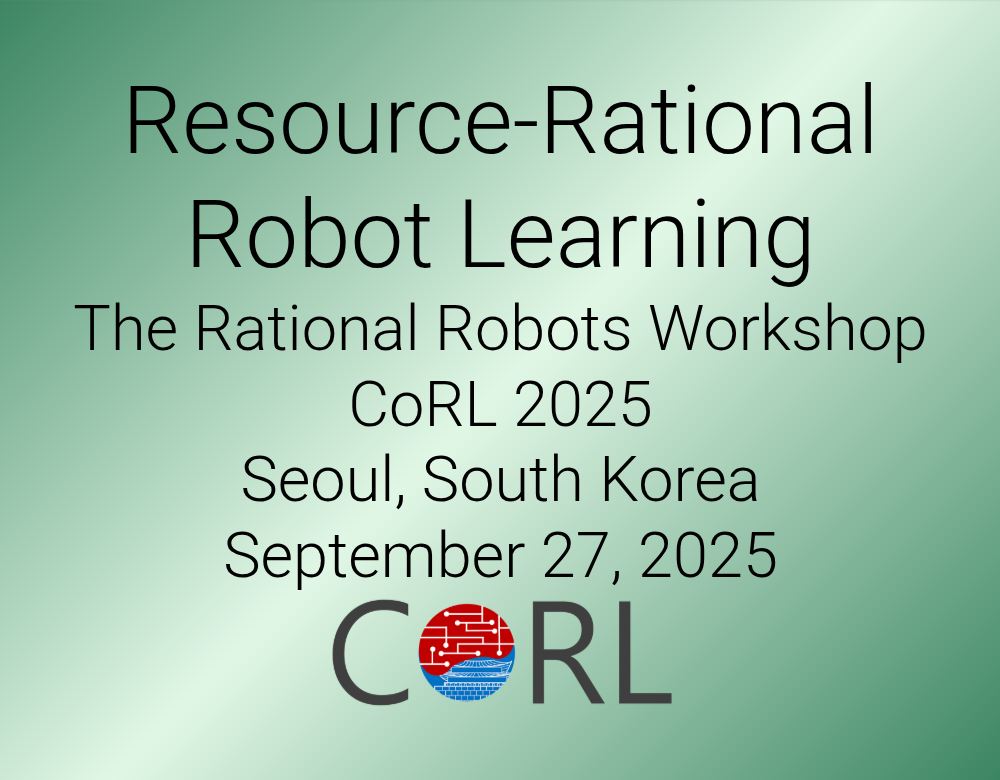
Resource-Rational Robot Learning Workshop @ CoRL 2025
Recent advances in robot capabilities, fueled by data-hungry learning algorithms and large-scale foundational models, are undeniably exciting. However, as we marvel at these advancements, a critical question arises: is the current trajectory of “scaling data and compute is all you need” sustainable or even desirable for robotics? Myopically committing to this path risks creating systems that are uneconomical and ill-suited for the various constraints imposed by physical embodiments, thereby limiting widespread adoption. Instead, just as evolution nurtured the emergence of efficient brains or how mature engineering disciplines meticulously navigate resource-performance trade-offs, it is imperative that robot learning as a field embeds resource consideration at every stage of the robot learning deployment lifecycle — from training and inference to continuous improvement and adaptation. This workshop will explore why designing for resource efficiency is beneficial, which resources should be considered for learning, and how they can be leveraged pragmatically to realize economical robot deployment. Towards this end, we seek to advance robot learning towards resource rationality: careful deliberation on how the robot should judiciously use resources (such as computation, time, and human assistance) based on their cost-performance tradeoff through all phases of learning. Through this lens, the benefits of resource-rational learning can be explored across a diversity of perspectives, such as the importance of models for principled, sample-efficient learning and inference; effectiveness of simulated data to complement costly real-world samples; leveraging human instructions, feedback, and priors to ground what is important to learn; understanding how much sensing and information is needed for a task; and the implications of resource rationality for today’s foundation models. Organizing Team: Shivam Vats, Tabitha Edith Lee, Arjun Krishna, Tony Chen, Jiayuan Mao, Glen Berseth, George Konidaris, Shao-Hua Sun, Dinesh Jayaraman.


Standing the Test of Time Workshop @ IROS 2024
Accurate, informative, and scalable world representations are an essential component of highly autonomous mobile robots and have been an important topic of research for several decades. As robots become more capable, deploying in larger and more dynamic, varied environments, requires for such representations to grow apace. Handling multiple data modalities, abstraction levels, and types of information (metric, topological, semantic, objects, etc.) remains challenging — even more so in so-called lifelong settings where robots must maintain world models over extended periods of time. Over the last forty years, roboticists have used techniques from many machine learning and statistics paradigms for mapping. However, none have been nearly as transformative as deep learning, and we believe we are now at an inflection point in the pace of adoption and proliferation of deep learning techniques for representing models of the world suited to robotics. Such a moment offers an opportunity for retrospection: to consider lessons from previous eras of research that have stood the test of time, to carry such lessons forward into an age of research dominated by models relying on latent representations, and to understand in hindsight the limits and blind spots of previous paradigms. Looking forward, we also hope to: make progress understanding the tradeoffs presented by newer learning and representation techniques, share and discuss new examples of state-of-the-art technical approaches for robotic mapping and modeling, and develop a shared view of the new frontier of challenges facing such systems as they are deployed in ever more challenging domains.

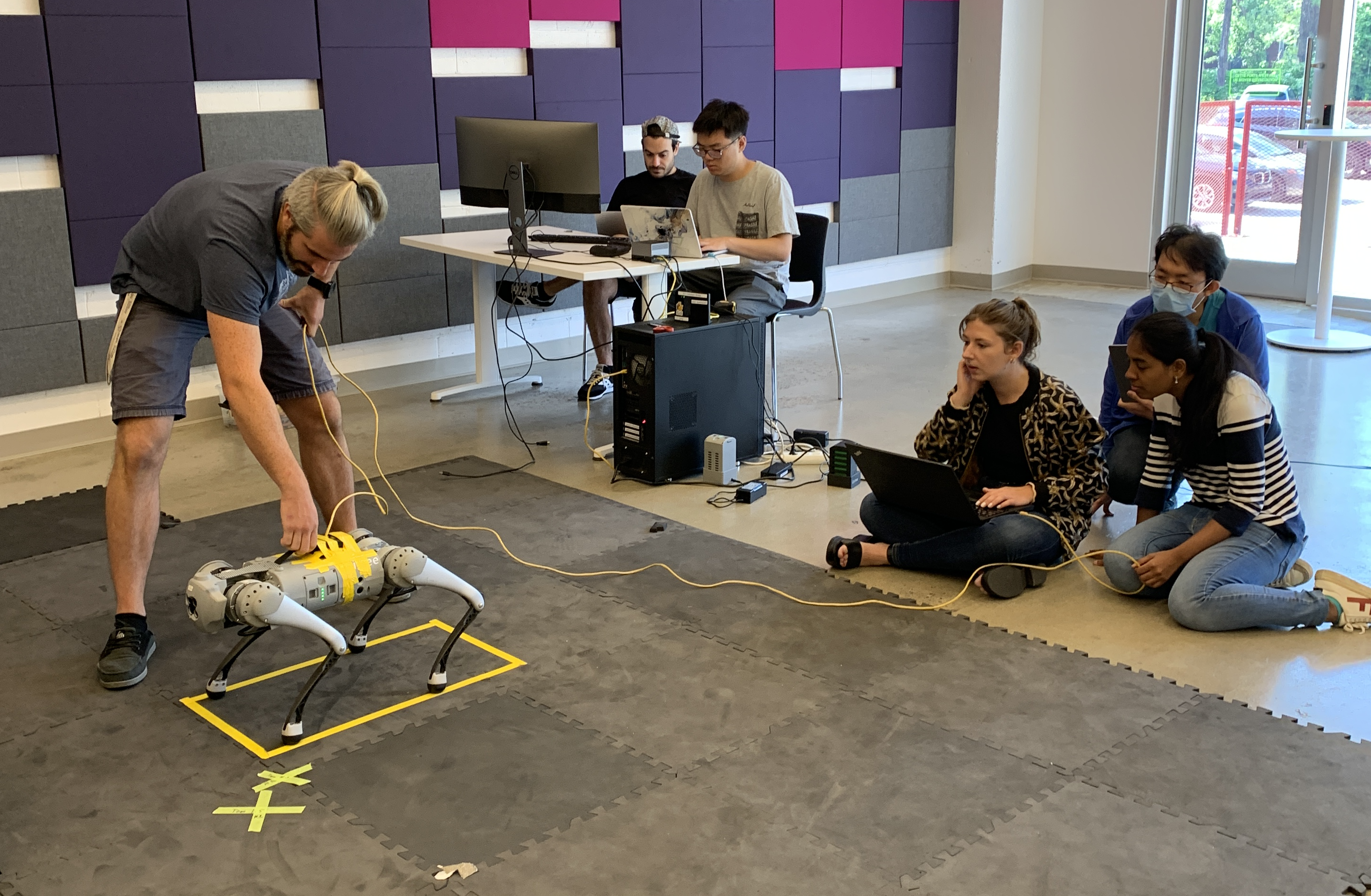
Montreal Robotics Summer School
Robotics is a rapidly growing field with interest from around the world. This summer school offers tutorials and lectures on state-of-the-art machine learning methods for training the next generation of learning robots. This summer school is an extension supported by the many robotics groups around Montreal.

Workshop on Physical Reasoning and Inductive Biases for the Real World
Workshop at NeurIPS 2021


The 6th AI Driving Olympics Competition
The 6th iteration of the AI Driving Olympics, taking place virtually at NeurIPS 2021. The AI-DO serves to benchmark the state of the art of artificial intelligence in autonomous driving by providing standardized simulation and hardware environments for tasks related to multi-sensory perception and embodied AI.

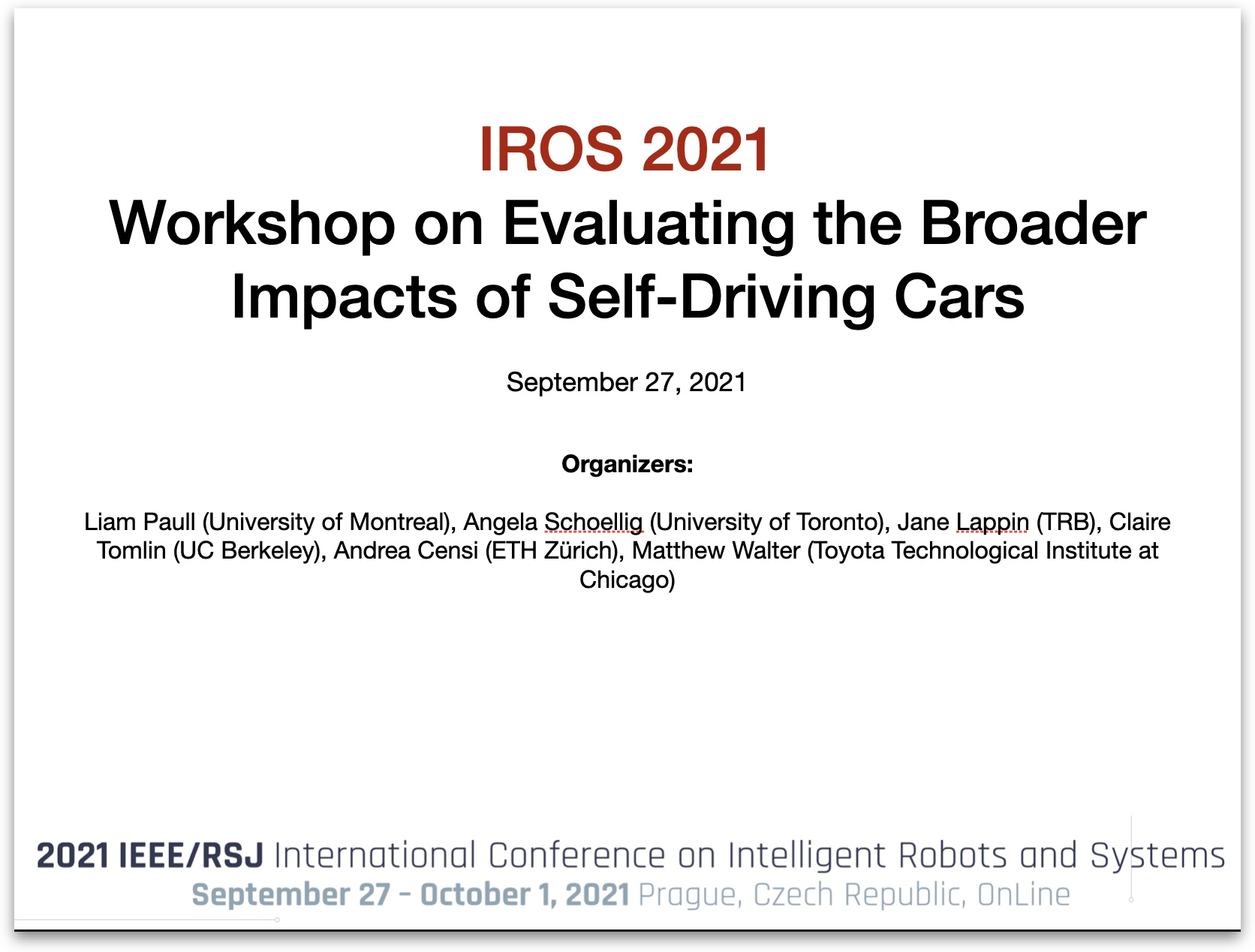
IROS 2021 Workshop on Evaluating the Broader Impacts of Self-Driving Cars
The primary objective of this workshop is to stimulate a conversation between roboticists, who focus on the development and implementation of autonomy algorithms, and regulators, economists, psychologists, and lawyers who are experts on the broader impacts that self-driving vehicles will have on society.
Winter 2021 Robot Learning Seminar Series
The Robotics and Embodied AI Lab and Mila are hosting the Winter 2021 edition of robot learning seminar series; a set of virtual talks by researchers in this field. Speakers this session include Steven Waslander, Animesh Garg, Sylvia Herbert, Georgia Chalvatzaki, Deepak Pathak, Pulkit Agrawal, Lilian Weng, Kelsey Allen, Manolis Savva, and Jiajun Wu.


Summer 2020 Robot Learning Seminar Series
The Robotics and Embodied AI Lab and Mila are hosting the Winter 2021 edition of robot learning seminar series; a set of virtual talks by researchers in this field. Speakers in this inaugural session include Stefani Tellex, Rika Antonova, Gunshi Gupta, Igor Gilitschenski, and Bhairav Mehta.
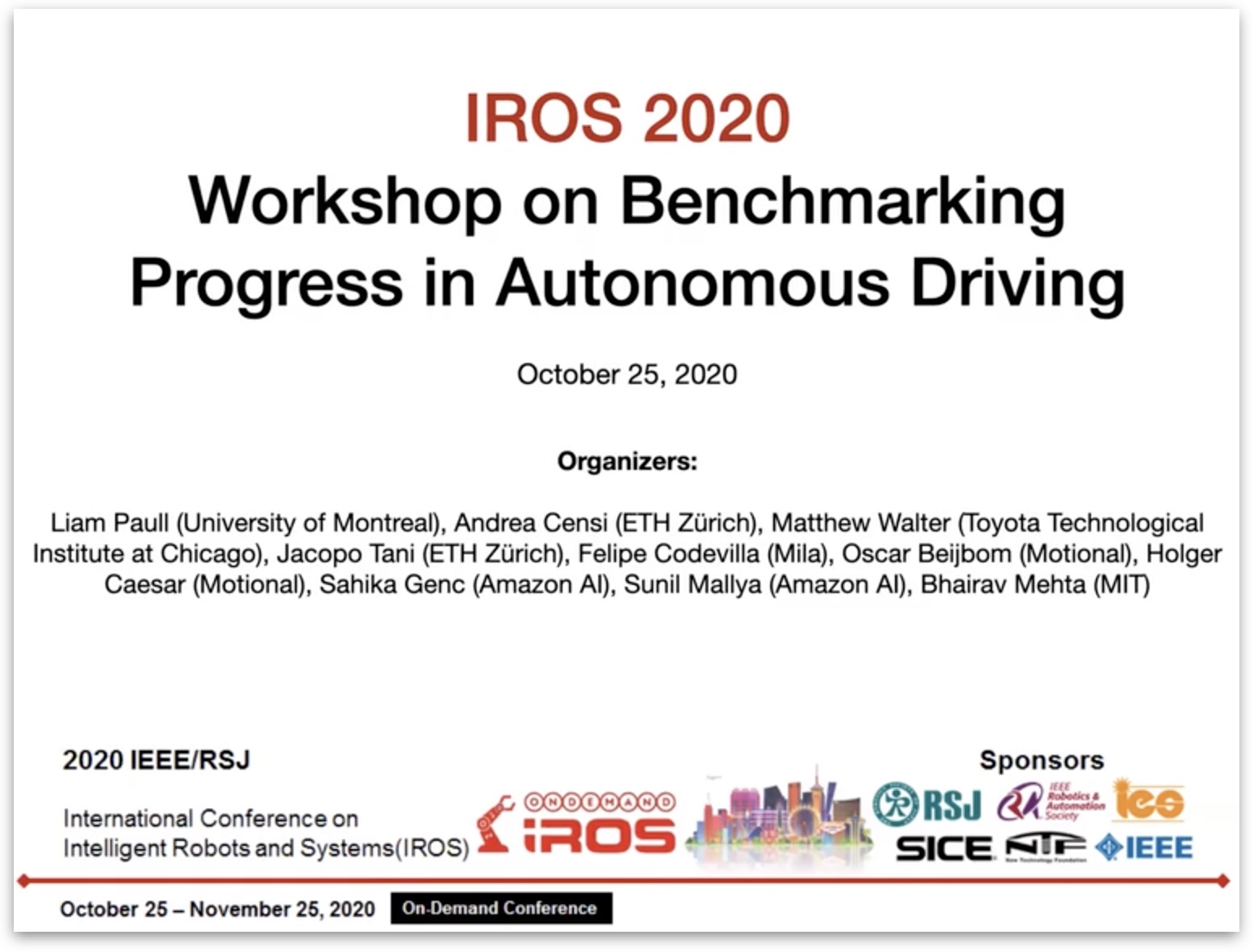
IROS 2020 Workshop on Benchmarking Progress in Autonomous Driving
Autonomous driving has seen incredible progress of-late. Recent workshops at top conferences in robotics, computer vision, and machine learning have primarily showcased the technological advancements in the field. This workshop provides an platform to investigate and discuss the methods by which progress in autonomous driving is evaluated, benchmarked, and verified.
Fall 2020 Robot Learning Seminar Series
The Robotics and Embodied AI Lab and Mila are hosting the Winter 2021 edition of robot learning seminar series; a set of virtual talks by researchers in this field. Speakers this session include Florian Shkurti, Valentin Peretroukhin, Ankur Handa, Shubham Tulsiani, Ronald Clark, Lerrel Pinto, Mustafa Mukadam, Shuran Song and Angela Shoellig.
 |
|
 |
|